Loading SSB Interview Academy...

SSB InterviewOfficer Selection Board Prep
All Over India
directorafadventure@gmail.com
All Over India
directorafadventure@gmail.com
Loading SSB Interview Academy...
Learn More
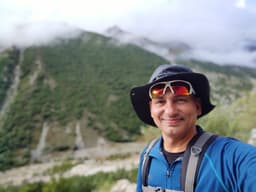
Former Fighter Pilot — Su-30 MKI
Mountaineer · Skydiver · River Rafter
Wing Commander (Dr) Satinder Singh Malikwas commissioned in the Indian Air Force in 1997 and served for 23 years as a fighter pilot, flying the Su-30 MKI fighter aircraft. He is a keen skydiver, river rafter, and mountaineer, having climbed peaks including Mt Stok Kangri, Mt Elbrus (Europe's highest), and Mt Kilimanjaro (Africa's highest). He was part of a mountaineering expedition in Antarctica and has also visited Mt Kailash and Mansarovar Lake in Tibet on a spiritual expedition.
He served as Director of the Indian Mountaineering Foundation and as Director of the Air Force Directorate of Adventure, where he led adventure-based leadership development programmes at the national level. His career spans 23 years of active service, including frontline flying missions and strategic roles in adventure-based leadership development.
Having faced the SSB himself and experienced first-hand how opaque and intimidating the process can be without the right guidance, Dr Malik founded this academy with a single mission: to democratise SSB preparation. He believes that every aspirant — regardless of their background, coaching budget, or location — deserves access to the same quality of preparation that helps candidates unlock their true officer potential. The platform is born from his own journey of struggle and discovery, not from a training pedigree.
Our academy brings GTO ground tactics and deep psychological tests to candidates nationwide. We focus on shaping the mind, speech, and actions — Manasa, Vacha, and Karmana — to naturally evolve raw aspirants into recommended military leaders. The approach is rooted in the belief that officer-like qualities cannot be memorized from textbooks; they must be cultivated through structured practice, honest self-reflection, and exposure to real-world problem-solving scenarios that mirror the challenges of the SSB assessment centre.
Every training module at our academy is reverse-engineered from actual SSB evaluation parameters. From the Screening Test on Day 1 through the Conference Procedure on Day 5, candidates are taken through a journey that demystifies each stage while simultaneously building the mental toughness and emotional maturity required to succeed. We do not merely prepare candidates for the SSB interview — we prepare them for the life and responsibilities of a commissioned officer in the Indian Armed Forces.
The 15 Officer Like Qualities (OLQs) assessed by the Services Selection Board form the backbone of our curriculum. Every psychological test, every GTO task, and every mock interview is designed to develop and demonstrate these qualities — from effective intelligence and reasoning ability to social adaptability, cooperation, and determination. Our candidates learn to internalize these qualities so deeply that their expression becomes second nature by the time they face the assessment board.
We also incorporate lessons from the Indian military's own leadership development framework. Concepts such as the 'Three Dimensional Leadership Model' — leading by example, leading through expertise, and leading through inspiration — are woven into our training methodology. This ensures that our candidates do not just clear the SSB but carry forward the ethos and values that define the Indian officer corps.
Specialized coaching based on real-world military survival and navigation tasks. Our adventure modules are designed to build risk-taking ability, initiative, and the capacity to function effectively under physical and mental stress.
Direct feedback blueprints aligned with actual Services Selection Board assessment criteria. Each candidate receives personalized evaluation reports that map their performance against the 15 OLQs and provide actionable improvement pathways for each quality.
Comparative Analysis
Synthesized and rephrased from three authoritative manuals: SSB Day-Wise Procedure, SSB Interview Guidelines, and the SSB Interview 2nd Edition.
The Personal Interview at the SSB is not a conventional question-and-answer session. It is a structured, depth-oriented conversation designed by a senior Interviewing Officer to uncover the authentic personality of the candidate. The interview is the culminating psychological assessment that cross-validates everything observed during the preceding days — the psychological tests, the GTO tasks, and the group discussions. A well-prepared candidate understands that the interview is not about giving 'correct' answers but about presenting a genuine, coherent, and self-aware personality that exemplifies the 15 Officer Like Qualities.
The Interviewing Officer (IO) establishes a relaxed, informal setting. By lowering your defenses, they build a rapport to observe your natural behavior.
For employed candidates: A deep dive into your duties, earnings, achievements, and work relationships. The focus is on finding a sense of purpose rather than mundane routine.
A complete review of academics from class VIII onwards. Focuses on subject preferences, co-curricular efforts, leadership roles, and how you financed your education.
Examines your family structure, parental occupations, pocket money management, and how you handle household responsibilities (repairs, utilities, helping parents).
Probes your spare time. Team sports are highly valued over individual games as they prove coordination, cooperation, and social effectiveness.
Tests your alertness on current international, national, and sports events, alongside rank systems, commands, and equipment of your chosen service branch.
A critical segment checking self-awareness. Candidates must state their strengths and developmental weaknesses honestly (avoiding red flags like depression).
The interview proceeds through multiple phases, starting from casual rapport-building to progressively deeper probes into the candidate’s life experiences, value systems, and decision-making frameworks. The Interviewing Officer is trained to detect inconsistencies, probe areas of hesitation, and evaluate the candidate’s responses against the parameters established by their psychological test results and GTO performance. This is why coordination between all your responses across the five days is essential. Every answer you provide in the interview must align with the personality profile that emerges from your TAT stories, WAT responses, SRT solutions, SDT write-up, and GTO behavior.
The officer-like quality most heavily weighted in the personal interview is 'Self-Confidence' followed closely by 'Effective Intelligence' and 'Ability to Influence Others.' The IO assesses these not through direct questions like "Are you confident?" but through indirect probes — how you describe your failures, how you react to criticism, how you articulate your future goals, and how honestly you appraise your own strengths and weaknesses. A candidate who demonstrates genuine self-awareness, balanced judgment, and a positive attitude toward learning from mistakes will score significantly higher than one who merely recites rehearsed accomplishments.
Mastering the SSB interview, therefore, requires more than content preparation. It requires developing a deep understanding of your own life story and being able to communicate it with clarity, conviction, and emotional resonance. Our academy emphasizes this through repeated mock interview sessions that simulate the pressure and depth of the actual IO conversation, followed by detailed feedback sessions that help candidates refine their narrative and delivery.
A senior Interviewing Officer has processed thousands of profiles over a career spanning decades. Every trick, every rehearsed answer, and every embellishment on the Personal Information Questionnaire (PIQ) is immediately recognizable. The IO has access to your complete psychological dossier — your TAT stories, WAT responses, SRT answers, and SDT self-description — alongside reports of your GTO performance. When you fabricate or exaggerate in the interview, it creates irreconcilable conflicts with this dossier. The board conference on Day 5 evaluates the candidate holistically; inconsistency across any two assessment dimensions is grounds for rejection.
The most common reason candidates fail at the interview stage is not a lack of knowledge but a failure of authenticity. They try to project what they think the board wants to see rather than who they truly are. This creates a fragile persona that crumbles under the IO’s probing. The candidate who walks into the interview room with genuine self-acceptance understands that the SSB is looking for trainability, not perfection. The board is evaluating your potential to develop into an officer through the training academy, not your current state of readiness.
Your thoughts (Manasa), speech (Vacha), and actions (Karmana) align perfectly. This consistency is the single highest driver for final recommendation in the Day 5 Board Conference. Every psychological test response, every GTO action, and every interview answer must tell the same story about your personality.
When asked a difficult question or a topic you are unaware of, responding "I do not know, Sir" truthfully projects confidence and security rather than stumbling into a trap of bluffs. The IO respects intellectual honesty far more than superficial knowledge. Admitting ignorance and demonstrating a willingness to learn is itself an officer-like quality.
IOs are senior officers who understand that humans commit mistakes and have imperfections. If you admit weak points honestly and demonstrate awareness of how you are working to overcome them, the board marks you for training potential rather than rejecting a false persona. The candidate who says "I have difficulty with public speaking but I have joined a local Toastmasters club to improve" shows far greater promise than one who claims to have no weaknesses.